
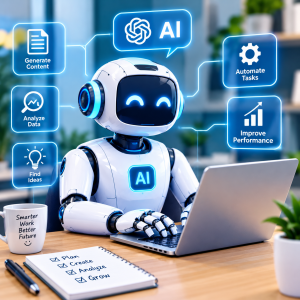
How AI Makes Our Work Easier:
Imagine completing a task in a few minutes that would normally take several hours. Imagine having a personal assistant who helps you write content, organize your schedule, answer questions, analyze information, and generate creative ideas. Sounds interesting, right? This is becoming possible with the help of Artificial Intelligence (AI).
Artificial Intelligence has become an important part of our daily lives. From smartphones and online shopping to education, healthcare, and digital marketing, AI is changing how people work and solve problems. It helps individuals and businesses save time, reduce repetitive tasks, and improve productivity.
Today, people do not always need to start every task from scratch. With the right AI tools, they can generate ideas, organize information, and find solutions more efficiently. However, AI is not just about working faster; it is also about working smarter.
In this blog, we will explore how AI makes our work easier, its benefits in different industries, and how we can use it effectively in our daily lives.
1. What Is Artificial Intelligence?
Artificial Intelligence is a technology that enables computers and machines to perform tasks that usually require human intelligence. These tasks may include understanding language, recognizing patterns, analyzing information, generating content, and answering questions.
For example, when you ask an AI assistant to explain a difficult topic in simple words, it can generate an explanation based on patterns learned during training. Similarly, AI tools can help you write emails, summarize documents, create images, and organize ideas.
AI does not think or understand everything exactly as a human does. It can also make mistakes, so its answers and recommendations sometimes need to be checked.
The main purpose of AI is to help people complete suitable tasks more efficiently and make better use of their time.
2. AI Saves Time and Increases Productivity
One of the biggest advantages of AI is that it can help us complete many tasks faster. In our busy lives, managing multiple responsibilities can be challenging. AI tools can assist with routine activities and reduce the time spent on certain tasks.
For example, imagine that you need to prepare a report, write an email, and organize your daily schedule. Instead of beginning each task without assistance, you can use AI to create a first draft, summarize important information, and arrange your priorities.
AI can also help with repetitive work, such as sorting information, categorizing customer feedback, and preparing basic summaries.
This allows people to spend more time on activities that require creativity, communication, problem-solving, and human judgment.
Example: A business owner can use AI to draft customer emails and prepare product descriptions, leaving more time to focus on customers and business growth.
3. AI Makes Education Easier for Students
Education is another area where AI can make a meaningful difference. Every student learns differently. Some understand a topic quickly, while others need additional explanations and practice.
AI learning assistants can explain complicated subjects in simple language, provide examples, generate practice questions, and help students identify areas they need to improve.
Students can use AI to:
- Understand difficult concepts.
- Prepare revision notes.
- Practice questions before examinations.
- Improve grammar and writing.
- Learn new languages.
- Explore topics beyond their textbooks.
For example, if a student finds mathematics difficult, they can ask an AI assistant to explain a problem step by step. The student can then practice similar questions to strengthen their understanding.
However, students should use AI as a learning partner rather than depending on it to complete every assignment. Understanding the subject and developing independent thinking remain essential.
4. AI Simplifies Digital Marketing
Digital marketing involves several activities, including search engine optimization (SEO), social media marketing, content creation, email marketing, and online advertising. Managing all these activities can take considerable time.
AI can help digital marketers plan campaigns, generate content ideas, analyze performance, and understand customer behavior.
Here are some common applications of AI in digital marketing:
Content Creation: AI can help marketers brainstorm blog topics, prepare content outlines, write initial drafts, and develop social media captions.
Search Engine Optimization (SEO): AI tools can assist with keyword research, content organization, search-intent analysis, and identifying possible improvements to website pages.
Social Media Marketing: Marketers can use AI to develop post ideas, create content calendars, and adapt messages for different platforms.
Email Marketing: AI can help draft email campaigns, suggest subject lines, and organize audience segments.
Advertising: AI-powered advertising systems can analyze campaign data and help marketers improve targeting, bidding, and performance.
For a digital marketing agency such as AarvikTech, these capabilities can make campaign planning and content production more efficient. However, successful marketing still requires human creativity, a clear understanding of the audience, and careful review of AI-generated content.
AI can support a marketing strategy, but it cannot guarantee higher rankings, more sales, or business success.
5. AI Helps Businesses Improve Customer Service
Customers often expect quick answers when they have questions about products, services, orders, or payments. Answering every question manually can be difficult, especially for businesses that receive many messages.
AI-powered chatbots can help businesses respond to common questions at any time of day. They can provide basic product information, explain delivery procedures, and guide customers toward useful resources.
For example, an online clothing store can use a chatbot to answer questions about available sizes, shipping policies, and return procedures.
AI can also help customer support teams summarize conversations and identify common customer problems.
Nevertheless, complicated complaints, sensitive situations, and unusual requests may require a human representative. Combining AI assistance with human support can provide a more helpful customer experience.
6. AI Supports Creativity and Content Creation
Many people have good ideas but struggle to turn them into finished content. Sometimes, they simply do not know where to begin.
AI can help overcome this challenge by suggesting ideas, creating outlines, exploring different writing styles, and generating visual concepts.
For example, a content creator who wants to publish a blog about digital marketing can ask AI for topic ideas, possible headings, frequently asked questions, and a basic article structure.
A designer can use AI image-generation tools to explore different visual concepts before creating a final design.
AI can also help people rewrite unclear sentences, improve grammar, and adjust the tone of their writing.
However, creative work becomes more valuable when people add their own experiences, original ideas, and personal understanding. AI-generated material should be reviewed carefully to ensure that it is accurate, appropriate, and original.
7. AI Makes Research and Data Analysis Easier
Research often involves reading documents, comparing information, and identifying important details. AI can help organize this information and make large amounts of material easier to review.
For example, a student can use an AI tool to summarize a lengthy document, while a business owner can use AI to organize customer feedback and identify recurring concerns.
Businesses can also use AI-powered analytics to examine sales trends, website activity, and customer behavior.
These insights can help people understand what is happening and identify questions that deserve further investigation.
However, AI-generated summaries and analyses are not always correct. Important facts, statistics, and business decisions should be checked against reliable sources and original data.
8. AI Helps People Learn New Skills
Learning new skills is important for personal and professional growth. However, people sometimes struggle to find suitable learning materials or understand unfamiliar topics.
AI can act as a learning assistant by explaining concepts, providing exercises, offering feedback, and suggesting a step-by-step learning plan.
For example, someone who wants to learn digital marketing can ask AI to explain SEO basics, suggest practice activities, and create a beginner-friendly study schedule.
Similarly, beginners can use AI to understand programming concepts, practice English communication, or explore graphic design principles.
The key is to practise what you learn instead of only reading AI-generated explanations. Real improvement comes from applying knowledge, making mistakes, and learning from experience.
9. Important Benefits of Using AI
When used responsibly, AI can provide several benefits:
- Time savings: Helps complete suitable tasks more quickly.
- Better productivity: Assists with organizing work and managing repetitive activities.
- Improved accessibility: Makes information and learning support easier to access.
- Creative support: Provides ideas and alternative approaches.
- Data analysis: Helps identify patterns in large amounts of information.
- Personalized learning: Adjusts explanations and practice activities to a learner’s needs.
- Business support: Helps teams organize information and improve certain workflows.
The benefits depend on the AI tool, the task, the quality of the information provided, and how carefully people review the results.
10. Challenges of AI and How to Use It Wisely
Although AI offers many advantages, it also has limitations. It can produce incorrect information, misunderstand instructions, or generate content that sounds convincing but contains mistakes.
There are also concerns about privacy, copyright, bias, and excessive dependence on automated tools.
To use AI effectively, follow these simple practices:
- Verify important facts using trustworthy sources.
- Avoid entering passwords, confidential business information, or unnecessary personal details into AI tools.
- Review AI-generated content before publishing or sharing it.
- Use AI to develop your skills instead of replacing your own learning.
- Apply human judgment when making important decisions.
- Be transparent about AI use when required by your school, workplace, or clients.
The best approach is to treat AI as an assistant that supports your abilities, not as a tool that makes every decision for you.
Conclusion
Artificial Intelligence is making our work easier by helping us save time, organize information, improve productivity, support creativity, and learn new skills. From students and employees to entrepreneurs and digital marketers, people across different fields can use AI to work more efficiently.
Whether you are writing a blog, preparing a presentation, managing a business, or planning a marketing campaign, AI can help you get started and simplify many parts of the process.
However, technology alone cannot guarantee good results. Human creativity, experience, critical thinking, and decision-making remain important.
The real advantage comes when we combine the speed of AI with human intelligence. By learning how to use AI responsibly and effectively, we can reduce unnecessary effort, focus on meaningful work, and prepare ourselves for the opportunities of the future.
Remember: AI does not simply help us work faster; when used wisely, it helps us make better use of our time, skills, and ideas.
Frequently Asked Questions (FAQs)
1. How does AI make our daily work easier?
AI helps people complete tasks such as writing, research, planning, data organization, and answering common questions more efficiently.
2. Can AI help students with their studies?
Yes. AI can explain difficult topics, generate practice questions, summarize learning materials, and provide writing feedback. Students should still develop their own understanding.
3. How is AI useful in digital marketing?
AI can assist with content creation, keyword research, social media planning, email marketing, audience analysis, and advertising optimization.
4. Can AI replace human workers?
AI can automate some tasks and change how certain jobs are performed. However, many roles still depend on human judgment, communication, creativity, and responsibility.
5. Is AI always accurate?
No. AI can generate incorrect or misleading information. Important facts and recommendations should always be verified.
6. How can beginners start using AI?
Beginners can start by using an AI assistant for simple tasks, such as explaining a topic, drafting an email, organizing a schedule, or generating ideas. They should review the results and practise using the tools responsibly.