Galleries

Artificial Intelligence

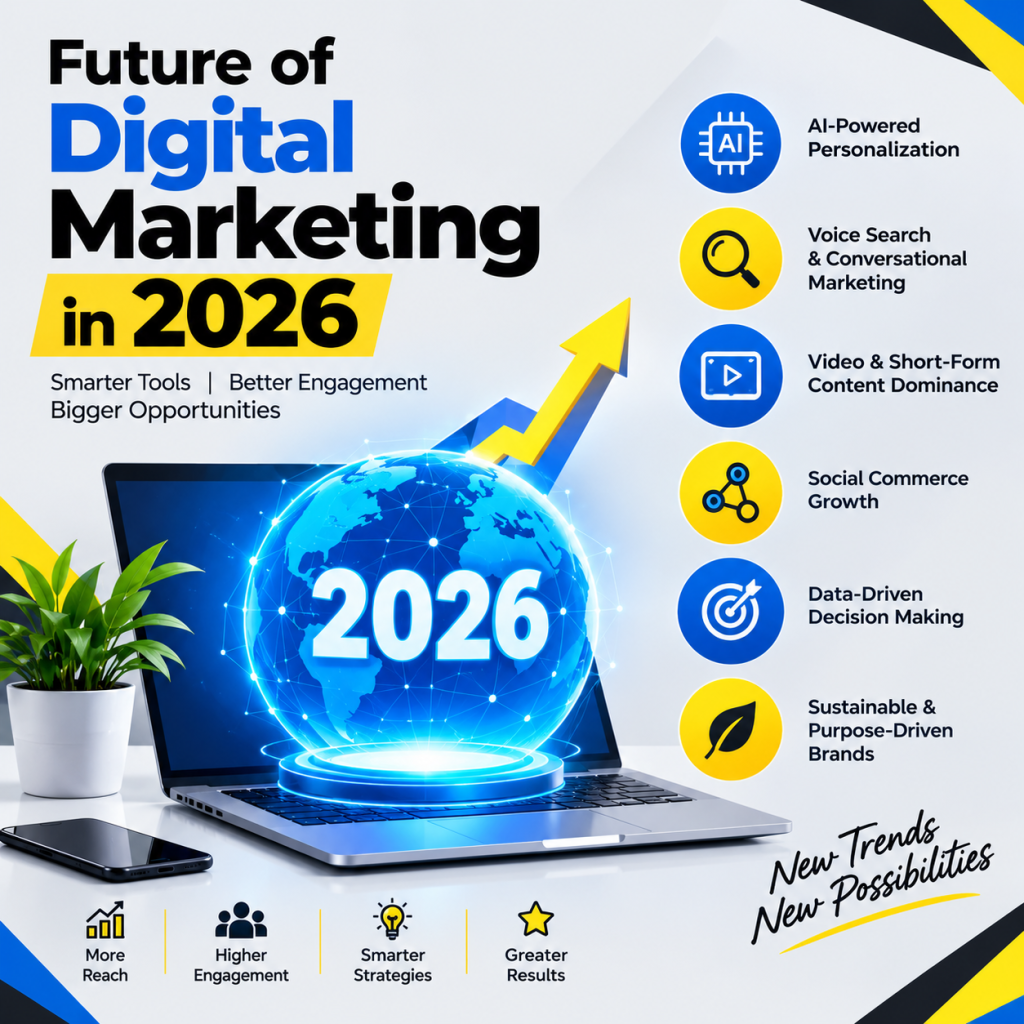
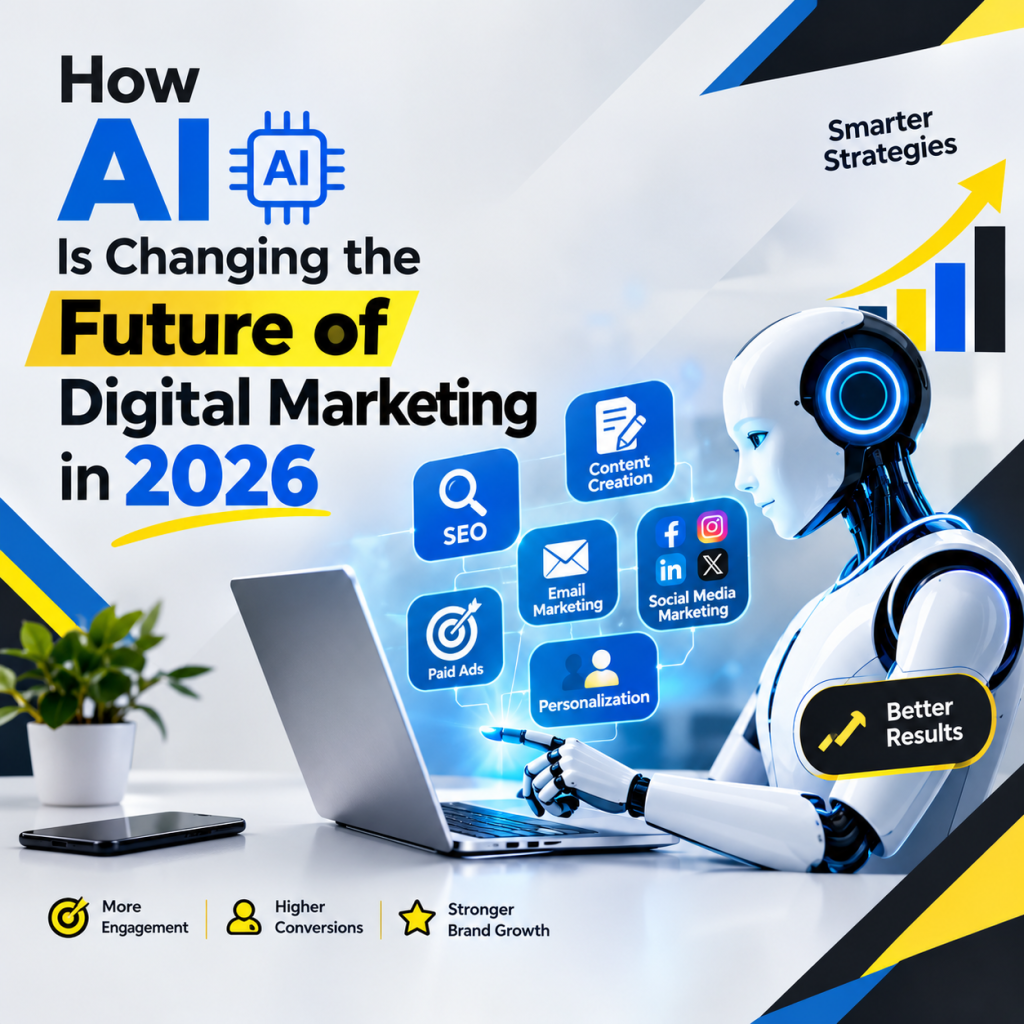
How AI Is Changing the Future of Digital Marketing in 2026?

AI is changing the way businesses attract customers, create content, and grow online. Discover how artificial intelligence is transforming digital marketing in 2026 and what it means for the future of your business. Introduction Think about how much digital marketing has changed in just a few years. Earlier, marketers spent hours researching keywords, writing content, designing advertisements, and analyzing campaign results. Today, artificial intelligence (AI) can help with many of these tasks in a fraction of the time. Welcome to the new era of digital marketing! In 2026, AI is becoming an important part of how businesses connect with customers. From small startups to established companies, businesses are using AI tools to understand their audiences, improve marketing campaigns, and make their work easier. A 2026 report from the World Federation of Advertisers highlights how brands are expanding their use of AI beyond content creation into research, advertising optimization, strategy, and automation. But does this mean that AI will replace digital marketers? Not necessarily. The real opportunity lies in combining the speed of AI with human creativity, experience, and understanding. Let’s explore how AI is changing the future of digital marketing in 2026. 1. AI Is Making SEO Smarter Search Engine Optimization (SEO) helps businesses appear in search results when people look for relevant products, services, or information. Traditionally, SEO involved researching keywords, analyzing competitors, improving website content, and monitoring search rankings. AI is making many of these activities faster and more convenient. With AI-powered tools, marketers can discover relevant keywords, understand what customers are searching for, identify content gaps, and find opportunities to improve website pages. Search itself is also changing. People increasingly use AI-powered tools to ask questions and discover information. This means businesses need to create content that answers real questions clearly and provides trustworthy information. For example, a digital marketing agency could publish a helpful article explaining how local SEO helps small businesses attract nearby customers. The goal is not simply to add keywords to a page. It is to give readers the information they genuinely need.   In 2026, successful SEO combines useful content, technical optimization, customer understanding, and a clear website structure. 2. AI Is Transforming Content Creation Creating fresh content regularly can be challenging. Businesses need blog posts, website pages, social media captions, email campaigns, and advertisements to keep their audiences engaged. This is where AI can make a real difference. AI tools can help marketers brainstorm ideas, prepare blog outlines, write first drafts, suggest headlines, and create social media captions. They can also help turn one piece of content into several formats. Imagine writing one detailed blog post and turning it into five social media posts, a short video script, and an email newsletter. AI can help make this process quicker. However, faster content creation does not automatically mean better content. Readers want useful information, relatable examples, and a genuine voice. Businesses should review AI-generated content, check facts, and add their own experience before publishing. The best content comes from combining AI’s efficiency with human creativity and originality. 3. AI Is Changing Social Media Marketing Social media has become an important part of everyday life. People use platforms such as Instagram, Facebook, LinkedIn, and YouTube to discover brands, learn about products, and share their experiences. For businesses, standing out in crowded social media feeds can be difficult. AI can help by suggesting content ideas, preparing captions, analyzing engagement, and organizing content calendars. It can also help marketers understand which topics and formats attract their audiences. For example, a clothing brand might discover that short videos showing how to style an outfit receive more engagement than ordinary product photographs. The brand can use this information to plan future posts. Still, social media is about people, not just numbers. Customers connect with honest stories, real experiences, humor, and meaningful conversations. AI can help create content, but a brand’s personality must come from the people behind it. 4. AI Is Improving Digital Advertising Online advertising through Google Ads and Meta Ads helps businesses reach potential customers and promote their services. AI is changing how these campaigns are managed. Depending on the platform and campaign type, AI-powered features can help with bidding, audience targeting, creative testing, and budget optimization. For example, a business selling handmade products could test different advertisement headlines and images to understand which combinations attract more customers. AI-powered systems can help analyze campaign performance and identify opportunities for improvement. However, AI cannot fix every advertising problem. If a website is difficult to use, an offer is unclear, or conversion tracking is inaccurate, a campaign may still perform poorly. Businesses should set clear goals, monitor spending, and evaluate whether advertisements generate meaningful results. Smart advertising is not about spending more money. It is about understanding what works and improving it. 5. AI Is Making Customer Experiences More Personal Have you ever received a product recommendation that matched exactly what you were looking for? Personalization can make shopping and browsing more convenient. AI helps businesses provide more relevant experiences by analyzing appropriate customer information and identifying patterns in interests and behavior. Businesses can use these insights to recommend products, personalize emails, organize customers into relevant groups, and tailor marketing messages. For example, an online bookstore might recommend books based on a customer’s previous purchases or stated interests. Similarly, a digital marketing agency could share different information with people interested in SEO, social media marketing, or Google Ads. When customers receive relevant information instead of unrelated promotions, their experience can improve. However, personalization must be handled responsibly. Businesses should respect privacy, protect customer information, and obtain consent where required. 6. AI Chatbots Are Making Customer Support Easier Imagine visiting a business website late at night and receiving an immediate answer to your question. AI chatbots are helping make this possible. They can answer common questions, explain services, guide visitors to useful pages, and collect enquiries outside normal business hours. For example, a visitor to the AarvikTech website might ask, “How can digital marketing help my business?” […]
Artificial Intelligence

How AI Makes Our Work More Accurate?

Artificial Intelligence is changing the way people work, learn, and manage their daily responsibilities. It can analyze information, identify patterns, check certain types of errors, organize data, and support better decision-making. From students and teachers to business owners and digital marketers, people across different industries are using AI to improve the quality of their work. However, AI is not perfect, and it can sometimes provide incorrect information. Its real value comes from helping people reduce avoidable mistakes, work more efficiently, and check their results more carefully. In this blog, we will explore how AI helps improve accuracy, its practical uses in different industries, and how people can use it responsibly to achieve better results. 1. What Is Accuracy in AI? Accuracy means how closely a result matches the correct answer, fact, measurement, or expected outcome. In professional work, accuracy is important because decisions often depend on the quality of the information available. For example, a student needs correct information to prepare an assignment, a business owner needs reliable sales figures to manage a company, and a digital marketer needs accurate campaign data to understand customer behavior. AI systems can help improve accuracy by processing information, recognizing patterns, comparing data, and checking for inconsistencies. Some AI tools can also identify spelling mistakes, detect unusual transactions, or flag information that may need further review. The results depend on the quality of the data, the design of the AI system, and the task being performed. Therefore, AI should be treated as a helpful assistant rather than a guarantee that every answer will be correct. 2. AI Helps Reduce Human Errors Human beings can make mistakes because of tiredness, distractions, pressure, or repetitive work. For example, someone preparing a large spreadsheet might accidentally enter a number incorrectly or overlook a missing value. AI-powered tools can help identify these issues by checking information for unusual patterns, missing details, and inconsistencies. Writing assistants can also highlight spelling and grammar problems before a document is shared. Imagine an employee preparing a report with hundreds of entries. An AI-assisted tool may flag duplicate records or values that look unusual, allowing the employee to investigate them. This does not mean that AI will identify every mistake. However, when combined with careful human checking, it can make many tasks more reliable. 3. AI Improves Accuracy in Education Education is one area where accurate information is especially important. Students need clear explanations, correct facts, and reliable learning materials to understand different subjects. AI learning tools can explain complicated topics in simple language, provide practice questions, identify possible errors in writing, and offer feedback on a student’s work. For example, a student writing an English essay can use an AI assistant to identify grammar mistakes and improve sentence structure. A mathematics student can ask for a step-by-step explanation of a problem and compare the method with their own work. AI can also help teachers organize learning materials and prepare quizzes. However, students should verify important facts using textbooks or trusted educational sources. AI can make mistakes in calculations, explanations, and historical details. The goal should be to understand the subject, not simply accept every answer provided by a tool. 4. AI Makes Digital Marketing More Accurate Digital marketing requires businesses to understand their audiences, create useful content, analyze campaign performance, and make informed decisions. Even small errors in a marketing campaign can affect its performance. AI can help digital marketers improve accuracy in several ways. Keyword research: AI tools can help organize keyword ideas and identify possible search intentions. Marketers should still check keyword data and search results using reliable SEO tools. Content checking: AI writing assistants can help identify grammar issues, unclear sentences, repeated phrases, and inconsistencies in website content. Audience analysis: AI-powered systems can analyze available customer data to identify patterns and potential audience interests. Advertising optimization: Advertising platforms use machine learning to help select audiences, manage bids, and optimize campaigns according to their objectives and available data. Performance reporting: AI can assist in summarizing website traffic, clicks, conversions, and other marketing metrics, making reports easier to understand. For a digital marketing agency such as AarvikTech, AI can help streamline content planning, support SEO activities, and organize campaign reports. Human review remains essential to confirm facts, protect customer data, and ensure that marketing messages are suitable for the intended audience. AI can support marketing accuracy, but it cannot guarantee top search rankings, perfect targeting, or successful campaigns. 5. AI Helps Businesses Make Better Decisions Business decisions often depend on sales figures, customer feedback, expenses, inventory levels, and market trends. An error in these details can lead to poor planning or unnecessary costs. AI-powered analytics tools can examine large amounts of business data and highlight patterns that may be difficult to notice manually. For example, a retail business can use an AI-supported system to identify products that sell more frequently during particular seasons. This information may help the business plan inventory more effectively. Similarly, a customer service team can analyze feedback to identify recurring complaints and areas that need improvement. AI provides useful insights, but business owners should check whether the underlying data is complete and up to date. Important decisions should also consider practical experience, business goals, and relevant risks. 6. AI Improves Accuracy in Data Entry and Analysis Working with large amounts of data can be time-consuming and challenging. Manually entering, sorting, and comparing hundreds or thousands of records increases the chance of mistakes. AI-assisted systems can help organize information, detect duplicate entries, identify unusual values, and classify records into suitable categories. For example, a company managing customer information might use an AI tool to identify records that appear to contain duplicate email addresses or incomplete details. AI can also help summarize large datasets and explain important trends in understandable language. However, unusual values are not always errors, and similar records are not always duplicates. People should review flagged information before making changes to important records. 7. AI Supports Accuracy in Healthcare Healthcare professionals must work with detailed […]

Artificial Intelligence

How AI Makes Our Work Easier ?

How AI Makes Our Work Easier:   Imagine completing a task in a few minutes that would normally take several hours. Imagine having a personal assistant who helps you write content, organize your schedule, answer questions, analyze information, and generate creative ideas. Sounds interesting, right? This is becoming possible with the help of Artificial Intelligence (AI). Artificial Intelligence has become an important part of our daily lives. From smartphones and online shopping to education, healthcare, and digital marketing, AI is changing how people work and solve problems. It helps individuals and businesses save time, reduce repetitive tasks, and improve productivity. Today, people do not always need to start every task from scratch. With the right AI tools, they can generate ideas, organize information, and find solutions more efficiently. However, AI is not just about working faster; it is also about working smarter. In this blog, we will explore how AI makes our work easier, its benefits in different industries, and how we can use it effectively in our daily lives. 1. What Is Artificial Intelligence? Artificial Intelligence is a technology that enables computers and machines to perform tasks that usually require human intelligence. These tasks may include understanding language, recognizing patterns, analyzing information, generating content, and answering questions. For example, when you ask an AI assistant to explain a difficult topic in simple words, it can generate an explanation based on patterns learned during training. Similarly, AI tools can help you write emails, summarize documents, create images, and organize ideas. AI does not think or understand everything exactly as a human does. It can also make mistakes, so its answers and recommendations sometimes need to be checked. The main purpose of AI is to help people complete suitable tasks more efficiently and make better use of their time. 2. AI Saves Time and Increases Productivity One of the biggest advantages of AI is that it can help us complete many tasks faster. In our busy lives, managing multiple responsibilities can be challenging. AI tools can assist with routine activities and reduce the time spent on certain tasks. For example, imagine that you need to prepare a report, write an email, and organize your daily schedule. Instead of beginning each task without assistance, you can use AI to create a first draft, summarize important information, and arrange your priorities. AI can also help with repetitive work, such as sorting information, categorizing customer feedback, and preparing basic summaries. This allows people to spend more time on activities that require creativity, communication, problem-solving, and human judgment. Example: A business owner can use AI to draft customer emails and prepare product descriptions, leaving more time to focus on customers and business growth. 3. AI Makes Education Easier for Students Education is another area where AI can make a meaningful difference. Every student learns differently. Some understand a topic quickly, while others need additional explanations and practice. AI learning assistants can explain complicated subjects in simple language, provide examples, generate practice questions, and help students identify areas they need to improve. Students can use AI to: Understand difficult concepts. Prepare revision notes. Practice questions before examinations. Improve grammar and writing. Learn new languages. Explore topics beyond their textbooks. For example, if a student finds mathematics difficult, they can ask an AI assistant to explain a problem step by step. The student can then practice similar questions to strengthen their understanding. However, students should use AI as a learning partner rather than depending on it to complete every assignment. Understanding the subject and developing independent thinking remain essential. 4. AI Simplifies Digital Marketing Digital marketing involves several activities, including search engine optimization (SEO), social media marketing, content creation, email marketing, and online advertising. Managing all these activities can take considerable time. AI can help digital marketers plan campaigns, generate content ideas, analyze performance, and understand customer behavior. Here are some common applications of AI in digital marketing: Content Creation: AI can help marketers brainstorm blog topics, prepare content outlines, write initial drafts, and develop social media captions. Search Engine Optimization (SEO): AI tools can assist with keyword research, content organization, search-intent analysis, and identifying possible improvements to website pages. Social Media Marketing: Marketers can use AI to develop post ideas, create content calendars, and adapt messages for different platforms. Email Marketing: AI can help draft email campaigns, suggest subject lines, and organize audience segments. Advertising: AI-powered advertising systems can analyze campaign data and help marketers improve targeting, bidding, and performance. For a digital marketing agency such as AarvikTech, these capabilities can make campaign planning and content production more efficient. However, successful marketing still requires human creativity, a clear understanding of the audience, and careful review of AI-generated content. AI can support a marketing strategy, but it cannot guarantee higher rankings, more sales, or business success. 5. AI Helps Businesses Improve Customer Service Customers often expect quick answers when they have questions about products, services, orders, or payments. Answering every question manually can be difficult, especially for businesses that receive many messages. AI-powered chatbots can help businesses respond to common questions at any time of day. They can provide basic product information, explain delivery procedures, and guide customers toward useful resources. For example, an online clothing store can use a chatbot to answer questions about available sizes, shipping policies, and return procedures. AI can also help customer support teams summarize conversations and identify common customer problems. Nevertheless, complicated complaints, sensitive situations, and unusual requests may require a human representative. Combining AI assistance with human support can provide a more helpful customer experience. 6. AI Supports Creativity and Content Creation Many people have good ideas but struggle to turn them into finished content. Sometimes, they simply do not know where to begin. AI can help overcome this challenge by suggesting ideas, creating outlines, exploring different writing styles, and generating visual concepts. For example, a content creator who wants to publish a blog about digital marketing can ask AI for topic ideas, possible headings, frequently asked questions, and […]

Artificial Intelligence

How AI Is Useful for the Youth Generation in 2026

  1. AI Is Making Education Easier and Smarter Education is one of the most important areas where AI can make a difference. Every student learns differently. Some understand a topic quickly, while others need more time, examples, or explanations. In a traditional classroom, teachers may not always have enough time to provide individual attention to every student. AI tools can help fill some of these learning gaps. Students can ask AI to explain difficult concepts in simple language, create revision notes, generate practice questions, and organize study schedules. For example, if a student struggles to understand mathematics, they can ask an AI tool to explain a problem step by step. If an English learner wants to improve grammar, AI can provide examples and practice exercises. AI can also help students prepare for examinations by identifying topics they need to revise. However, students should not use AI simply to copy answers and complete assignments without understanding them. The real purpose of education is to develop knowledge and independent thinking. AI works best as a personal learning assistant, not as a replacement for teachers or genuine learning. 2. AI Is Helping Young People Build Career Skills The job market is changing, and young people need to prepare for new opportunities. Employers increasingly value practical skills, adaptability, communication, problem-solving, and the ability to learn new technologies. AI can help young people develop these abilities. For example, someone interested in digital marketing can use AI to brainstorm campaign ideas, practise writing advertisements, understand SEO basics, and learn how social media strategies work. A student interested in programming can use AI to explain coding concepts, identify errors, and practise solving problems. Similarly, young people preparing for employment can practise interview questions, improve their résumés, and prepare professional introductions. These activities can help build confidence before entering the workplace. However, AI-generated advice is not always accurate, and employers still value genuine skills and experience. Young people should combine AI-assisted learning with practical projects, internships, training, and real-world experience. 3. AI Is Opening Doors to New Career Opportunities AI is changing existing jobs while also creating demand for new skills and specializations. Young people who understand how to use AI responsibly may find opportunities in areas such as digital marketing, data analysis, software development, automation, graphic design, and AI-assisted content production. For example, a young person interested in graphic design can use AI tools to brainstorm concepts and explore different visual styles. They can then develop their own designs and build a professional portfolio. Someone interested in digital marketing can learn how to research keywords, prepare content calendars, analyze campaign performance, and use AI-assisted marketing tools. These skills can support employment, freelancing, or entrepreneurship. Still, learning an AI tool alone does not guarantee a job. Young people must understand the underlying subject and demonstrate that they can solve real problems. The biggest opportunity belongs to young people who combine AI knowledge with strong practical skills. 4. AI Is Helping Young Entrepreneurs Start Businesses Have you ever dreamed of starting your own business but felt confused about where to begin? AI can help young entrepreneurs take their first steps. Starting a business often requires research, planning, marketing, customer communication, and financial decision-making. These tasks can feel overwhelming, especially for beginners with limited resources. AI tools can help young entrepreneurs brainstorm business ideas, identify potential audiences, prepare business plans, draft promotional messages, and organize tasks. For example, a young entrepreneur planning to launch an online clothing store could use AI to explore product ideas, develop a brand identity, create social media content, and draft product descriptions. A student offering freelance services could use AI to prepare a portfolio outline and develop ideas for reaching potential customers. However, business ideas must be tested in the real world. AI cannot guarantee customer demand, profitability, or business success. Young entrepreneurs should conduct proper research, understand their budgets, protect customer information, and make informed decisions. 5. AI Is Boosting Creativity and Innovation Young people often have exciting ideas but may not know how to turn them into reality. AI can help bridge that gap. From writing stories and creating presentation outlines to brainstorming video concepts and exploring design ideas, AI can support creative work in many ways. For example, a young content creator can use AI to generate ideas for educational videos. A student preparing a presentation can use it to organize information into clear sections. An aspiring writer can use it to explore different story directions. AI-powered design tools can also help beginners experiment with layouts, illustrations, and visual concepts. But creativity is not simply about producing something quickly. It involves personal experiences, emotions, imagination, and a unique point of view. Young people should use AI to develop their ideas rather than allowing it to make every creative decision for them. AI can provide the starting point, but your imagination gives the final work its personality. 6. AI Is Making Digital Marketing More Accessible Digital marketing offers young people opportunities to promote businesses, develop professional skills, and work with clients. In 2026, AI is helping beginners explore areas such as search engine optimization (SEO), social media marketing, content marketing, and online advertising. AI tools can help generate content ideas, draft social media captions, research customer questions, and organize marketing calendars. For example, a young freelancer working with a local business could use AI to plan a month of social media content, research relevant topics, and prepare ideas for promotional campaigns. This can make it easier to practise marketing skills and manage tasks efficiently. However, effective digital marketing requires more than AI-generated posts. Young marketers must understand customer behavior, brand identity, audience research, analytics, and campaign strategy. For young people interested in this field, learning AI alongside traditional marketing skills can be a valuable step toward building a career. 7. AI Can Help Young People Improve Communication Good communication is essential for education, employment, friendships, and business. AI can help young people improve their writing, practice conversations, learn languages, and prepare […]

Artificial Intelligence

How AI Is Changing the Future of Digital Marketing in 2026?

Welcome to the new era of digital marketing! In 2026, AI is becoming an important part of how businesses connect with customers. From small startups to established companies, businesses are using AI tools to understand their audiences, improve marketing campaigns, and make their work easier. A 2026 report from the World Federation of Advertisers highlights how brands are expanding their use of AI beyond content creation into research, advertising optimization, strategy, and automation. But does this mean that AI will replace digital marketers? Not necessarily. The real opportunity lies in combining the speed of AI with human creativity, experience, and understanding. Let’s explore how AI is changing the future of digital marketing in 2026. 1. AI Is Making SEO Smarter Search Engine Optimization (SEO) helps businesses appear in search results when people look for relevant products, services, or information. Traditionally, SEO involved researching keywords, analyzing competitors, improving website content, and monitoring search rankings. AI is making many of these activities faster and more convenient. With AI-powered tools, marketers can discover relevant keywords, understand what customers are searching for, identify content gaps, and find opportunities to improve website pages. Search itself is also changing. People increasingly use AI-powered tools to ask questions and discover information. This means businesses need to create content that answers real questions clearly and provides trustworthy information. For example, a digital marketing agency could publish a helpful article explaining how local SEO helps small businesses attract nearby customers. The goal is not simply to add keywords to a page. It is to give readers the information they genuinely need.   In 2026, successful SEO combines useful content, technical optimization, customer understanding, and a clear website structure. 2. AI Is Transforming Content Creation Creating fresh content regularly can be challenging. Businesses need blog posts, website pages, social media captions, email campaigns, and advertisements to keep their audiences engaged. This is where AI can make a real difference. AI tools can help marketers brainstorm ideas, prepare blog outlines, write first drafts, suggest headlines, and create social media captions. They can also help turn one piece of content into several formats. Imagine writing one detailed blog post and turning it into five social media posts, a short video script, and an email newsletter. AI can help make this process quicker. However, faster content creation does not automatically mean better content. Readers want useful information, relatable examples, and a genuine voice. Businesses should review AI-generated content, check facts, and add their own experience before publishing. The best content comes from combining AI’s efficiency with human creativity and originality. 3. AI Is Changing Social Media Marketing Social media has become an important part of everyday life. People use platforms such as Instagram, Facebook, LinkedIn, and YouTube to discover brands, learn about products, and share their experiences. For businesses, standing out in crowded social media feeds can be difficult. AI can help by suggesting content ideas, preparing captions, analyzing engagement, and organizing content calendars. It can also help marketers understand which topics and formats attract their audiences. For example, a clothing brand might discover that short videos showing how to style an outfit receive more engagement than ordinary product photographs. The brand can use this information to plan future posts. Still, social media is about people, not just numbers. Customers connect with honest stories, real experiences, humor, and meaningful conversations. AI can help create content, but a brand’s personality must come from the people behind it. 4. AI Is Improving Digital Advertising Online advertising through Google Ads and Meta Ads helps businesses reach potential customers and promote their services. AI is changing how these campaigns are managed. Depending on the platform and campaign type, AI-powered features can help with bidding, audience targeting, creative testing, and budget optimization. For example, a business selling handmade products could test different advertisement headlines and images to understand which combinations attract more customers. AI-powered systems can help analyze campaign performance and identify opportunities for improvement. However, AI cannot fix every advertising problem. If a website is difficult to use, an offer is unclear, or conversion tracking is inaccurate, a campaign may still perform poorly. Businesses should set clear goals, monitor spending, and evaluate whether advertisements generate meaningful results. Smart advertising is not about spending more money. It is about understanding what works and improving it. 5. AI Is Making Customer Experiences More Personal Have you ever received a product recommendation that matched exactly what you were looking for? Personalization can make shopping and browsing more convenient. AI helps businesses provide more relevant experiences by analyzing appropriate customer information and identifying patterns in interests and behavior. Businesses can use these insights to recommend products, personalize emails, organize customers into relevant groups, and tailor marketing messages. For example, an online bookstore might recommend books based on a customer’s previous purchases or stated interests. Similarly, a digital marketing agency could share different information with people interested in SEO, social media marketing, or Google Ads. When customers receive relevant information instead of unrelated promotions, their experience can improve. However, personalization must be handled responsibly. Businesses should respect privacy, protect customer information, and obtain consent where required. 6. AI Chatbots Are Making Customer Support Easier Imagine visiting a business website late at night and receiving an immediate answer to your question. AI chatbots are helping make this possible. They can answer common questions, explain services, guide visitors to useful pages, and collect enquiries outside normal business hours. For example, a visitor to the AarvikTech website might ask, “How can digital marketing help my business?” A chatbot could explain the basics of SEO, social media marketing, and online advertising before directing the visitor to the contact page. This helps businesses respond quickly and makes it easier for potential customers to find information. However, chatbots should not replace human support completely. Customers may still need a real person when discussing complex requirements, making important decisions, or resolving complaints. The best customer experience combines quick automated assistance with friendly, knowledgeable human support. 7. AI Is […]

Scroll to Top